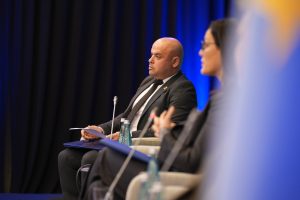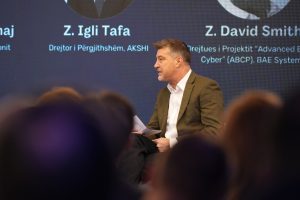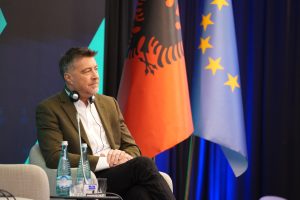
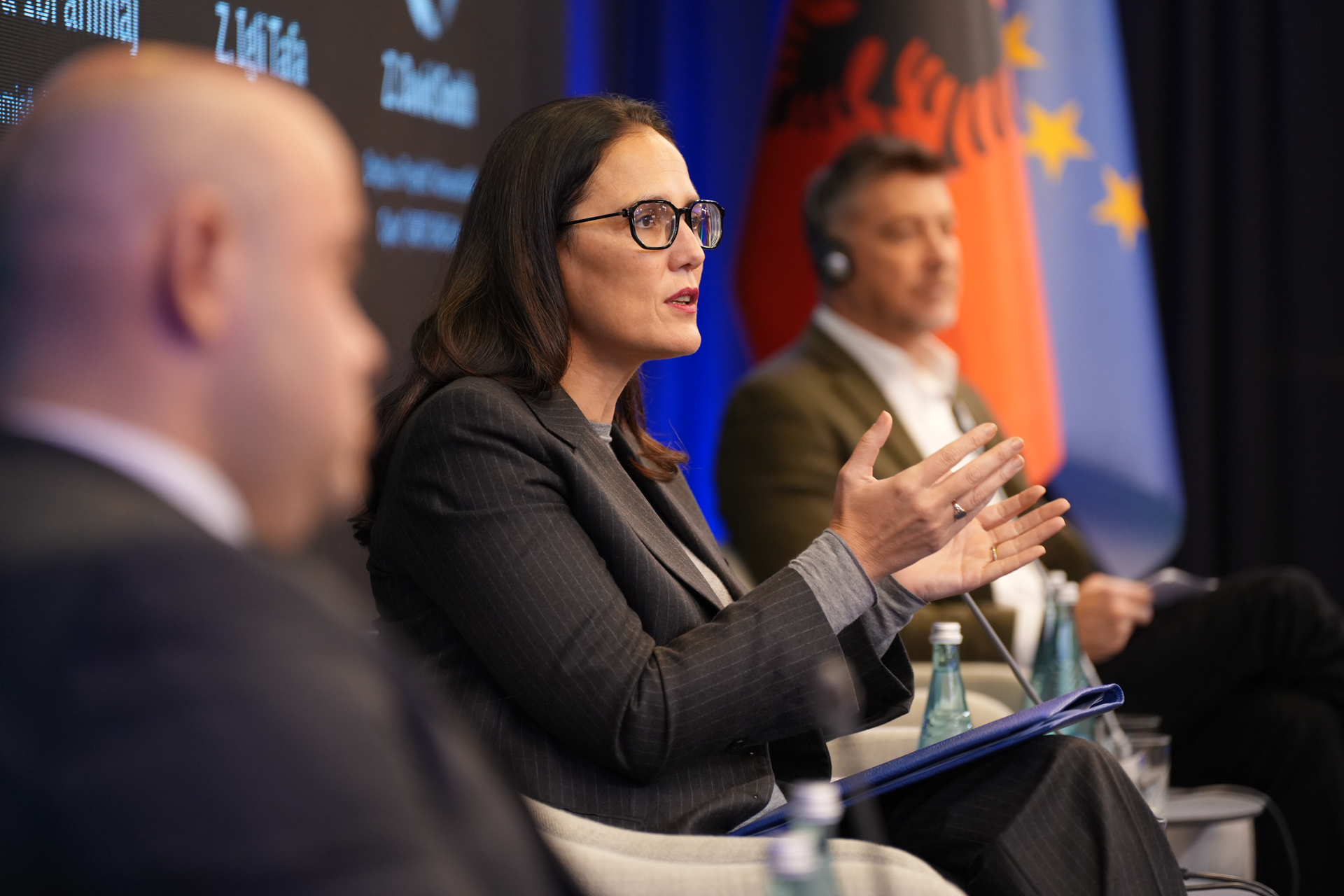
The security of digital services, the protection of critical infrastructure, and the impact of artificial intelligence on evolving threats were at the centre of the first panel of the National Cybersecurity Conference, organised by the National Cyber Security Authority (AKSK) on 3 November 2026 in Tirana.
The panel featured Delina Ibrahimaj, Minister of Economy and Innovation, and David Smith, Project Lead for “Advanced Balkan Cyber” (ABCP), BAE Systems. Moderated by AKSK Director General Bledar Kazia, the discussion focused on the need to accompany digital transformation with investment in security, strengthen defensive capabilities, and prepare institutions and businesses for emerging cyber threats.
In his opening remarks, Bledar Kazia emphasised that cybersecurity is directly linked to the functioning of the economy, national security, and citizens’ daily lives. He noted that the expansion of digital services and the integration of systems create new opportunities for development while also increasing the number of potential entry points for attackers. Progress in cyber defence must therefore be supported by continued investment and adaptation to increasingly sophisticated malicious actors.
Cybersecurity as Part of Economic Development
Responding to a question about the pace of security investment compared with digital transformation, Minister Delina Ibrahimaj reflected on the lessons learned from the 2022 cyberattack. She acknowledged that the initial development of systems and the digitalisation of public services had not been matched by an equivalent pace of development in protective infrastructure. That attack elevated cybersecurity to a new level of priority, prompting stronger capabilities, increased funding, and the development of the legal framework.
Ibrahimaj stressed that cybersecurity requires attention across all areas of the economy. Businesses rely on technology to process payments, store data, and manage their operations, while a cyberattack can disrupt or bring those operations to a standstill.
In this context, she highlighted the needs of small and medium-sized enterprises, which do not always have financial and technical resources comparable to those of sectors such as banking or telecommunications. Raising awareness of risks and providing education on preventive measures were identified as important ways to strengthen the protection of these businesses.
The Minister also addressed workforce development through education, vocational training, and specialised courses. She welcomed young people’s interest in the field and underlined the importance of supporting businesses that provide cybersecurity services and solutions. In her view, the public sector has a role in setting and monitoring standards, while developing private-sector capabilities is necessary to meet market demand.
Assessing Albania’s role in regional security, Ibrahimaj stated that the capabilities developed, including with support from international partners, have strengthened the country’s position as a reliable partner.
Understanding Systems and Building Response Capabilities as Foundations of Cyber Defence
David Smith brought an international perspective to the discussion on evolving threats and recurring organisational weaknesses. He stressed that artificial intelligence is changing how attacks are developed and how much they cost, enabling faster operations on a wider scale. Identity and credential theft, alongside risks associated with third parties and supply chains, were among the issues discussed.
According to Smith, a fundamental requirement for effective defence is a comprehensive understanding of an organisation’s technology environment: the devices connected to its network, the software in use, and the services that depend on them. This understanding enables organisations to assess risk and prioritise investment according to the importance of their systems and the potential consequences of a compromise.
He emphasised that purchasing and deploying technology alone cannot guarantee security. Teams’ ability to detect threats, respond to incidents, and recover systems is decisive. Investment in technology must therefore be accompanied by the development of expertise, infrastructure upgrades, and the preparation of incident response procedures.
The Use of Artificial Intelligence and the Protection of Information
The discussion on future developments focused on artificial intelligence and quantum technologies, highlighting the difficulty of accurately predicting emerging threats. Smith stressed the need to build capabilities that allow organisations to adapt, starting with the maintenance, updating, and proper management of existing systems.
Bledar Kazia drew attention to the use of artificial intelligence in developing platforms and systems. He emphasised that the benefits of faster development must be accompanied by careful consideration of the vulnerabilities these solutions may contain.
The panel also addressed the risk of exposing personal and institutional information when using artificial intelligence platforms. Smith underlined the importance of defining the intended purposes of use, testing solutions, and planning protective measures before integrating them into work processes.
Awareness and Shared Responsibility
Questions from the audience broadened the discussion to include public and business awareness, system segmentation, and capacity-building initiatives. In his responses, Smith emphasised that changing user culture and behaviour remains one of the most difficult cybersecurity challenges. Education should reach schools, communities, and different age groups, making data protection and the safe use of technology part of everyday knowledge.
During the panel, Bledar Kazia reiterated the support AKSK provides to operators of critical and important infrastructure through assistance and, in certain cases, technological solutions. Acknowledging the resource constraints operators may face, he called for greater attention to security investment and capacity development.
The discussion highlighted that addressing cyber threats requires sustained commitment, with technology, workforce preparedness, and leadership responsibility advancing together. For institutions and businesses, preparedness begins with understanding their risks and systems, followed by concrete measures to protect services and enable an effective response when an incident occurs.
Video: Watch the panel discussion